Appendix
Measuring Engagement, 2014: placing the Flamingo sculpture
Part of Measuring Engagement, a 2014 study by the Iota team at SapientNitro. How the walk is drawn gives the method.
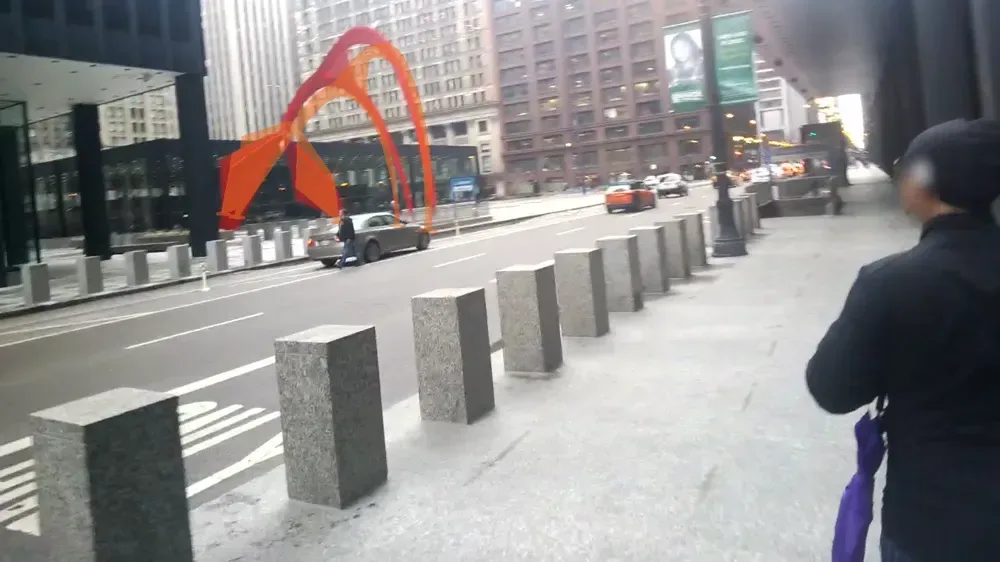
This appendix. It records how Alexander Calder’s sculpture Flamingo (1974), 53 ft tall and on the route, was placed in the team’s 3D model of the streets, using the video. It also tests the walker’s path, which was worked out from the same video in 2026. A published 3D model of the sculpture, at full size, lines up with the real one in the video, and its position is good to about 6 ft.
Why a sculpture
The route runs south down Dearborn Street: past the Marquette Building, across Adams Street, through Federal Plaza, where the sculpture stands, under the Kluczynski tower and across Jackson Boulevard. The page draws these streets as outlines, from a 3D model that the team built in 2014. The team placed the walk in that model by hand. In 2026, software worked out the path from the video itself, and a path worked out that way can be wrong in ways that are hard to see.
Flamingo makes a fair test. It is the easiest thing on the route to recognise, the walk passes within about 70 ft of it, and its height is published. The team’s model did not include it, so nothing had been fitted to it. If the path is sound, one position and one size should put the sculpture on the real one in every frame.
- Height, measured from the video
- 52.8 ftCalder’s published figure is 53 ft
- Position, in the team’s model
- About ±6 ftalong Dearborn Street, and ±3 ft across it
- Evidence
- 37 framesof the video, from 5:25 to 6:08
The placement in each frame
Each picture is a frame of the video with two things drawn over it. Orange is the 3D model of the sculpture. Blue-green is the buildings and curbs of the team’s 2014 model. Both use the same single placement in every frame, with nothing adjusted for any one of them. Times are minutes and seconds into the video. Faces are blurred, as in the video on the walk page.
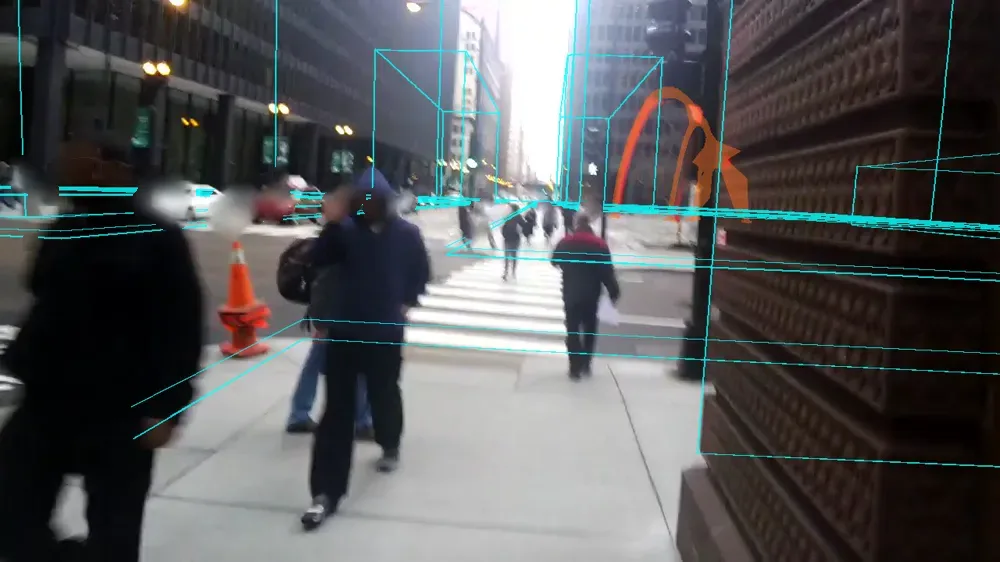
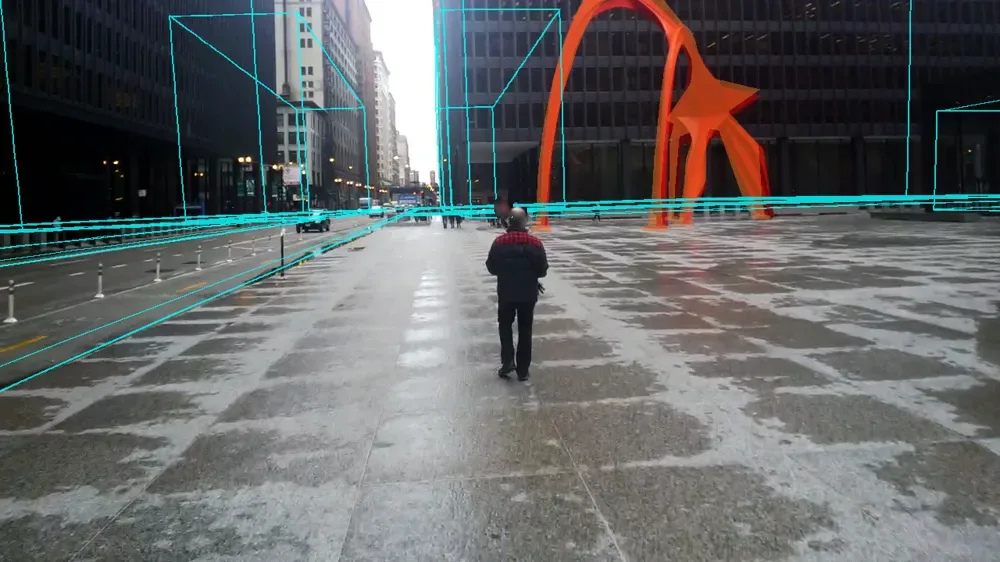
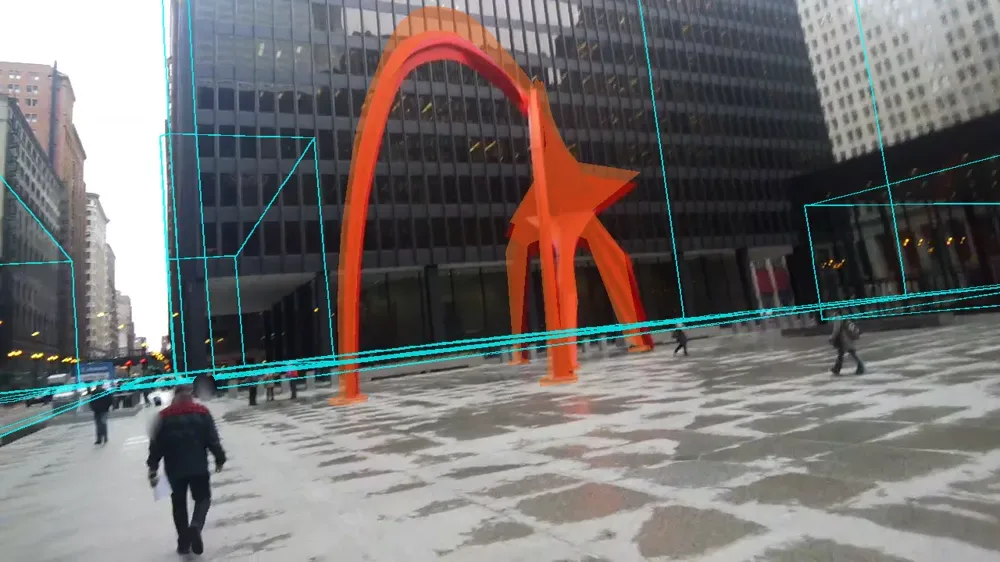
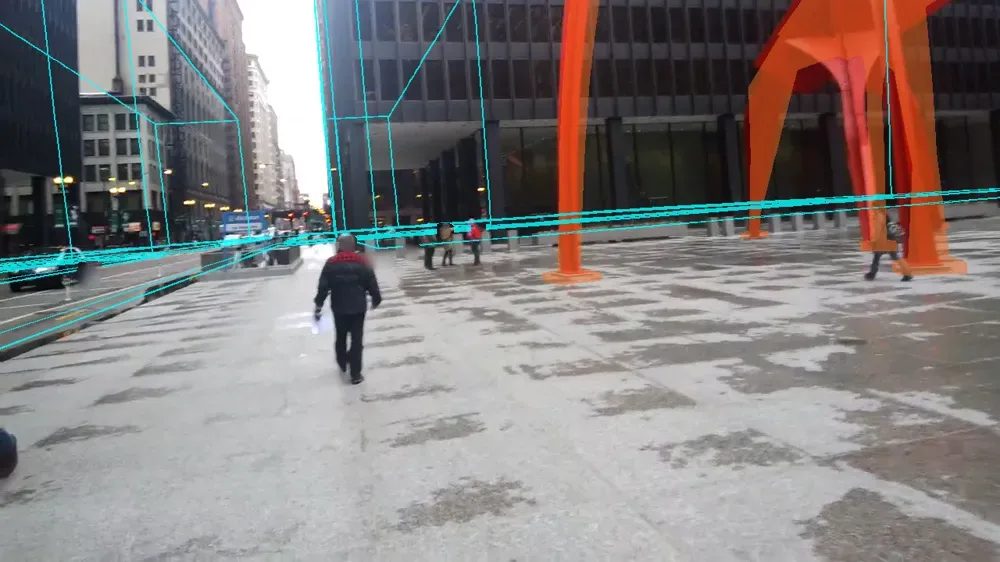
Where the walker was in each frame
| Video time | Distance to the sculpture | Direction the camera faced |
|---|---|---|
| 5:22 | 283 ft | 175° |
| 5:48 | 154 ft | 184° |
| 6:00 | 99 ft | 207° |
| 6:06 | 76 ft | 193° |
How it was measured
- Turn the video into a path. Run on the original Glass video at 3 frames a second, COLMAP’s longest unbroken stretch holds 406 frames and about 50,000 points in 3D, from 5:13 to 7:41. It also measures the lens: about 75° across.
- Find the ground. Of the 34,487 points near the path that could be ground, 24,553 lie on one flat plane, within 4 in. That plane says which way is up.
- Fit the sculpture. Its red stands out, so each frame gives a clean silhouette. The 3D model is drawn from each frame’s camera position, and a search finds the place, turn and size where drawing and silhouette overlap most, across all 37 frames at once.
- Set the size. Structure from motion has no units: it cannot tell a small scene from a large one. So something of known size has to set them. The three measures below were compared.
- Line it up with the team’s model. Eight building corners, read by eye from zoomed frames, and the curbs of Adams Street and Jackson Boulevard set how the path turns and shifts to sit on the 2014 model.
At the final placement, the drawing and the silhouette overlap by an average of 0.38, where 1 would be perfect, and three of the 37 frames score under 0.2. That score punishes thin shapes heavily, so it is useful for comparing fits and says little as an absolute grade.
Three separate measures of size
In the software’s own units, the sculpture’s height is firm. What needs settling is how many inches each unit is worth. Each row sets that in a different way, then shows what it would make the sculpture’s height, the height of the Glass above the ground, and the walking pace. A wrong size would show up as an implausible height or pace. They agree within about 3%.
| Size set by | Sculpture’s height | Height of the Glass | Walking pace |
|---|---|---|---|
| The walker’s measured eye height, 69.25 in (adopted) | 52.8 ft | 69.25 in, by definition | 4.87 ft/s |
| Calder’s published height, 53 ft | 53 ft, by definition | 69.7 in | 4.89 ft/s |
| The block from Adams to Jackson in the 2014 model | 54.2 ft | 71.3 in | 5.00 ft/s |
The eye height is the most direct check, because it compares two heights inside the same reconstruction, so no unit is needed. It was measured standing, in 2026, and the effects of shoes, gait and where Glass sits were not measured.
Check against building fronts
The software also found points on real building fronts, and the alignment was not fitted to them, which makes them a fair test. With the alignment adopted, they land 0.7 ft from the north face of the Kluczynski tower in the team’s model, and 2.3 ft from that of the Monadnock Building. That result decided between the four alignments tried.
The four alignments compared
| Lined up using | Tower north face | Monadnock north face | Adams curb | Jackson curb |
|---|---|---|---|---|
| Corners only | +12.7 ft | +13.0 ft | +14.1 ft | +23.1 ft |
| Curbs and corners, sized by eye height (adopted) | +0.7 ft | +2.3 ft | +1.4 ft | +12.2 ft |
| Curbs and corners, sized by the block | −4.9 ft | −9.4 ft | +2.2 ft | +2.0 ft |
| Curbs and corners, at a larger size | −3.5 ft | −13.5 ft | +11.1 ft | −0.8 ft |
A positive number means the real building front or curb lies north of where the 2014 model draws it. The curbs are part of the fit in the last three rows. The two building columns are independent in every row.
What this does not settle
- Corners and curbs disagree. At the same size, building corners alone would put the sculpture 7 to 20 ft further north. Corners seen along a street say little about position along it, but the disagreement is not resolved.
- Jackson’s curb is 12 ft off with this alignment, though the Monadnock’s front just beyond it is 2.3 ft off. The alignment is weaker further from the sculpture.
- The walk out and the walk back do not join. The software would not combine them into one reconstruction. From the far sidewalk on the way back, the sculpture’s east-west position comes out within about 4 ft, a rough check that says nothing north-south.
- The real plaza. The position is relative to the team’s 2014 model, which has not been checked against a survey.
- The sculpture’s shape. The 3D model is someone’s careful reconstruction, not Calder’s drawings.
The fit uses the video’s frames and the model’s buildings. It uses none of the Glass sensor readings, which come from the second trip.
Sculpture: Alexander Calder, Flamingo, 1974. 3D model: “The Flamingo” by BoldlyBuilding, licensed under CC BY 4.0, used at its own size and otherwise unchanged. Reconstruction: COLMAP. Building outlines: the Iota team’s 2014 model. The walk and its instrumentation were a team effort by Iota, at SapientNitro; this measurement was made in 2026.